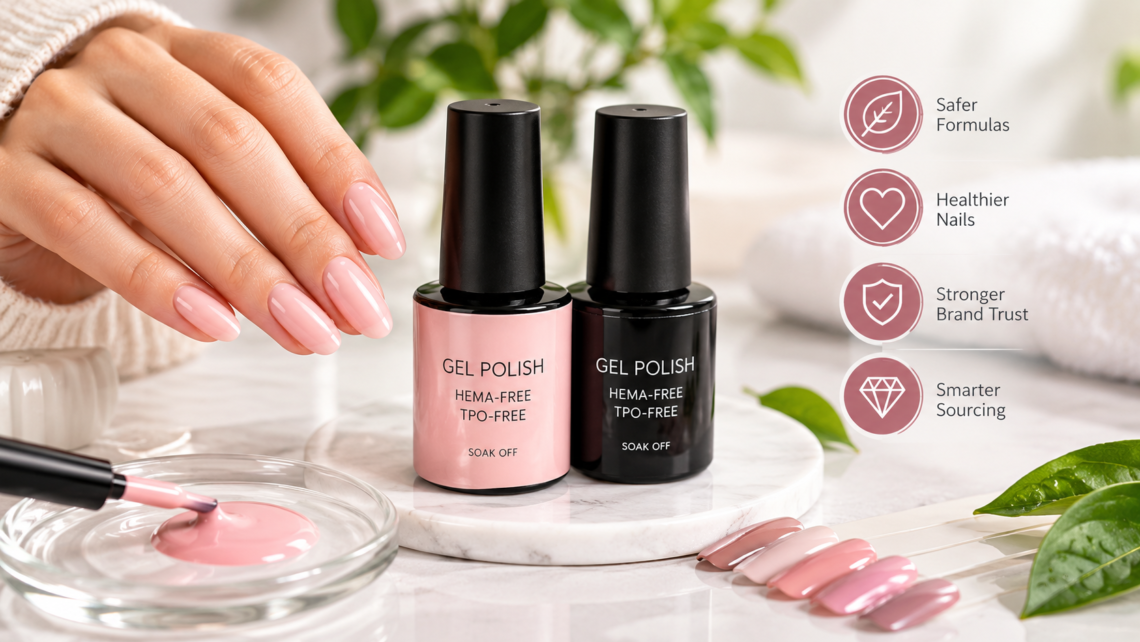
HEMA-free and TPO-free gel polish leaves out two ingredients. Regulators now treat both as high-risk. HEMA is a monomer that triggers skin allergies. TPO is a curing agent the EU banned outright in 2025. Sell gel polish in Europe and both now decide what you can legally stock.
Most brands found this out the hard way. A shipment held at customs. A product pulled from shelves. A supplier who swore the formula was “compliant” and was not.
This guide covers what changed, why it matters, and how to source correctly. Read it before you place your next order.
What HEMA-free and TPO-free actually mean
Two different ingredients. Two different problems. Do not confuse them.
HEMA stands for 2-hydroxyethyl methacrylate. It helps gel stick to the nail. It also sensitises skin, and once a client reacts, the allergy is usually permanent.
TPO is a photoinitiator. It makes gel harden under a UV or LED lamp. Without it, or a safe replacement, the gel never cures.
A HEMA-free, TPO-free formula removes both and swaps in safer alternatives. The polish still cures. The allergy risk drops sharply.
The 2025 TPO ban changed everything
This is the part most brands underestimate. The EU did not restrict TPO. It banned it.
From 1 September 2025, TPO is prohibited in all cosmetics sold in the EU. Regulators reclassified it as a CMR 1B substance. That label means toxic to reproduction. It was added to Annex II of EU Cosmetic Regulation 1223/2009.
The ban has no concentration exemption. It applies to brands, distributors, and salons alike. Professionals cannot even use up old stock.
So any gel polish containing TPO is now unsellable in the EU. Check the INCI list on every formula you stock.
The HEMA rule came earlier, and it still applies
HEMA is restricted, not banned. That distinction matters.
Under EU Regulation 2020/1682, HEMA is allowed only in professional nail products. It came into force in 2021. Two warnings became mandatory on the label: “For professional use only” and “Can cause an allergic reaction.”
So you can still sell HEMA gel in the EU. But only to professionals, and only with the correct warnings. Sell it to consumers and you are non-compliant.
Many brands skip the complication entirely. They go HEMA-free and open both retail and professional channels.
“HEMA-free” does not mean allergen-free
Here is where cheap suppliers cut corners. They swap HEMA for another sensitiser and still call it “HEMA-free.”
The common replacement is HPMA. It is classified as a skin sensitiser too. A formula can be technically HEMA-free and still cause reactions.
So the label alone is not proof. Ask which monomer replaced the HEMA. Then check that monomer’s safety data before you commit.
A serious HEMA free gel polish supplier hands over the full INCI list and test reports. No hesitation. One that dodges the question is hiding something.
What to check before you source
Compliance lives in the paperwork, not the marketing. Ask for all of it.
Five documents separate a real manufacturer from a trader:
- INCI list and SDS, so you can verify every ingredient by CAS number
- A CPSR, the EU safety assessment for each formula
- CPNP notification support for the EU market
- ISO 22716 and GMP certification for the factory
- Third-party test reports confirming HEMA-free and TPO-free claims
Verify the claim against the CAS numbers, not the headline. TPO has one CAS number. HEMA has another. The SDS does not lie, even when the sales page does.
Also ask which photoinitiator replaced TPO, and at what level. That answer tells you whether the supplier actually understands the new rules.
Why private label makes this easier
Building your own compliant formula from scratch costs years. A private label route skips that.
A good private label gel polish manufacturer already holds compliant base formulas. You add your colour range, your bottle, your label, and your brand. The compliance work is done.
This matters most right now. Brands that were private-labelled from a HEMA-free, TPO-free factory were ready early. The 2025 ban did not surprise them. Brands sourcing from traders scrambled.
Look for a factory, not a middleman. Factories control the formula and run their own lab. They prove every claim with documents.
Factory versus trader: what changes
| Factor | Source factory | Trader or reseller |
| Formula control | Owns and adjusts it in-house | Buys from someone else |
| Compliance docs | Issues CPSR, SDS, test reports directly | Forwards whatever it receives |
| MOQ | Often low, from a few pieces | Set by the hidden factory |
| Custom colour | Develops it in its own lab | Limited to stock |
| Problem fixing | Reformulates when needed | Depends on a third party |
Always ask to see the factory certifications in the manufacturer’s own name. A trader cannot produce them.
Frequently asked questions
What is HEMA-free gel polish?
It is gel polish made without 2-hydroxyethyl methacrylate. That monomer commonly triggers permanent skin allergies. The formula swaps in gentler ingredients and still cures normally.
Is TPO really banned in the EU?
Yes. From 1 September 2025, TPO is prohibited in all cosmetics sold in the EU. There is no concentration exemption and no sell-through of old stock.
Does HEMA-free mean allergen-free?
No. Many formulas replace HEMA with HPMA, which is also a skin sensitiser. Always check which monomer the supplier used.
Can I still sell HEMA gel polish in Europe?
Yes, but only to professionals. The two required warnings must appear on the label. Consumer sales of HEMA gel are not compliant.
What documents prove a formula is compliant?
Ask for six things: the SDS, INCI list, a CPSR, CPNP support, ISO 22716 certification, and third-party test reports.
Why choose a factory over a trading company?
A factory owns the formula and issues compliance documents in its own name. It can adjust the product too. A trader depends on a hidden third party for all of it.
What is the MOQ for private label gel polish?
It varies by supplier. Factories that hold stock formulas can start very low. Some offer a few pieces as samples before a bulk run.
How do I verify a HEMA-free claim?
Match the ingredients against their CAS numbers in the SDS. HEMA and TPO each carry a specific CAS number. It cannot hide in the data.
Is TPO banned in the US too?
No. As of 2026, there is no US federal ban on TPO or HEMA. If you sell into the EU, you build to the stricter EU standard.
Before you place your order
Check the regulation first, the colour second. A beautiful shade means nothing if customs reject the shipment.
Confirm the formula is HEMA-free and TPO-free with documents, not promises. Match every claim to a CAS number. Ask which ingredients replaced the banned ones.
Sourcing from a compliant factory protects your brand on day one. You get products you can sell in both the EU and US. You get full paperwork for customs. You get no recall risk hanging over your launch. Request samples and test reports together. Then build your line on a formula that stays legal next year.